The Future as Time, the Future as an Idea
Why the concept of a future needs an update.

There is the future as time—a continuous state of unfolding in causality. And there is the future as an idea—a constructed, projected vision of future states.
Modeling the Future for Extraction
For most of human history, thoughts on the future had fewer verifiable vectors. Life was observed at a slower pace; data was local, and our own experiences were metabolized at the same rate as what’s nearby.
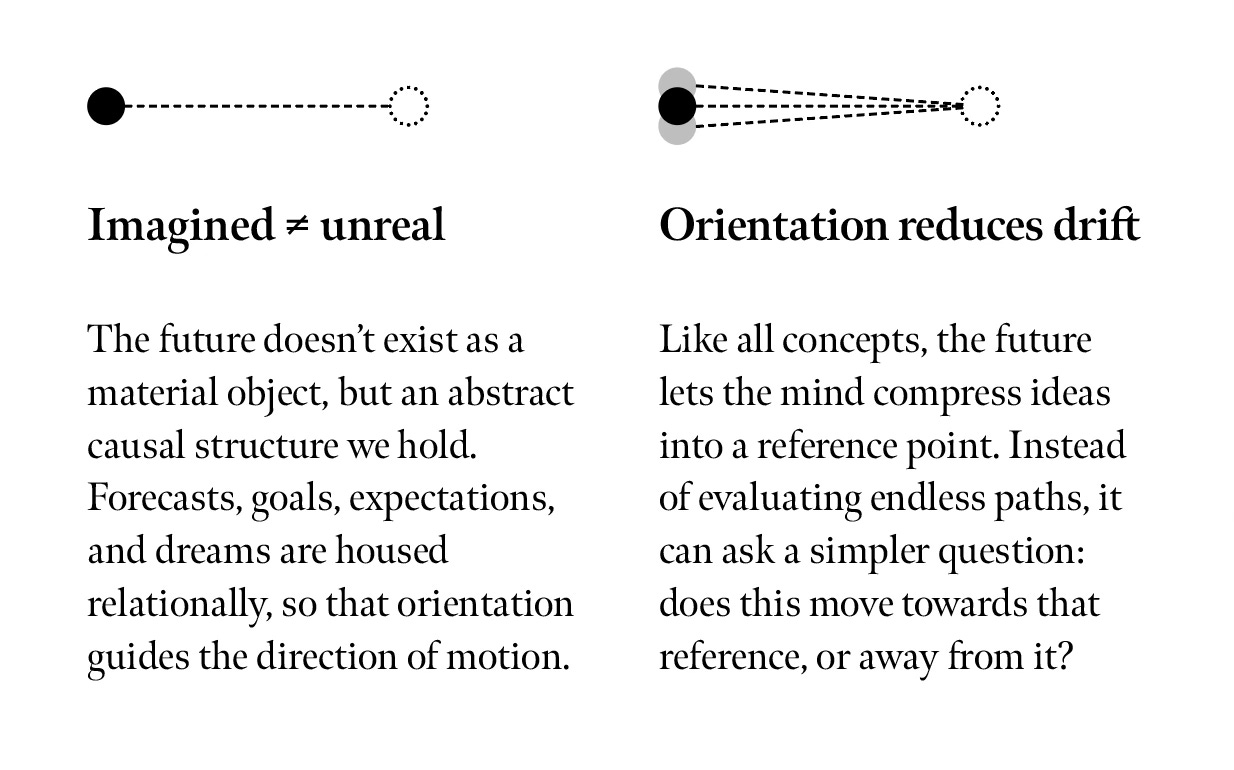
But as we got better at turning what’s imagined into reality—the future, as an idea, became excessively modeled for extraction rather than orientation. As a result, what was likely took precedence over what could be.
The future stopped being something we moved toward with intimacy, longing, and hope. It became a predictive market, a managed landscape, a logistical exercise. Risk-adjusted. Probability-weighted and optimized for capture.
Without a shared orientation toward futures worth longing for, control moved inward. Collective dreaming gave way to individual manifesting — a type of personal future technology.
Unpriced Energies, Rising Density
Unpriced energies such as intention, meaning and projection circulated through invisible thresholds, accelerating interconnectivity and learning. We currently live in a higher causal density that demands a new ontological frame.
Events cascade faster. Second-order effects arrive before first-order effects are processed. The gap between action and consequence are all over the place making it impossible to see the bigger picture clearly.
To work with this density, we need to rethink what the future is—especially how we relate to the futures we long for.
The Future As Interface
We need to update our temporal philosophy.
The future is not a destination we’re moving toward. It is an interface.
An interface doesn’t care about content; it cares about compatibility. It doesn’t determine whichoutcomes occur—it structures how they can occur. Think of boundary conditions in physics: they don’t solve the equation; they define what counts as a solution.
The past and future are not fixed and open, respectively. Both are active interfaces. The past is continuously renegotiated as new evidence and interpretation arrive. The future is already being structured by the exchange conditions—the protocols, incentives, and permissions.
Our task shifts from extraction to design. We don’t just build the future; we create the rules of engagement for what can pass from possibility into actuality.
Applied to our world, this looks less like planning and more like protocol design:
Expiration Dates for Digital Objects are not mere scheduling. They are an interface that defines a relationship with time itself. A tool that says, “I will work fully until 2030, then archive,” creates a shared temporal boundary between maker and user. It makes the relationship finite, intentional, and respectful of the future’s right to be different. The interface filters out the possibility of perpetual, obsolete clutter.
Consent Layers That Fade operationalize the interface of trust. Permissions that degrade unless actively renewed make visible a fundamental truth: connection is a choice repeatedly made, not a state permanently granted. This interface doesn’t assume the future; it requires the future to consciously re-engage, filtering out passive, zombie relationships.
Posthumous Identity as a Live Protocol is perhaps the purest example. Instead of a will that tries to control outcomes from the grave, you encode a responsive filter: “My estate supports my descendants’ education—but only for fields that didn’t exist when I died.” You are not dictating the future. You are designing an interface that remains active, allowing only certain kinds of novelty and adaptation to pass through.
The future-as-interface is a governance layer for possibility. By designing these protocols—for expiration, consent, and legacy—we stop trying to capture what’s likely and start architecting the conditions for what we deem worthy of becoming real. We move from extracting the future to orienting it.